
Presentation New York February 7, 2024

On 7 February 2024, at the Italian Cultural Institute of New York, the book Giovanni da Verrazzano, Navigatore e Gentiluomo by Marco Hagge was presented.
After the introductory greetings by the Director of the Italian Cultural Institute, Prof. Fabio Finotti, the President of the Italian Heritage Committee, Joseph Sciame, speaking remotely from Mexico, opened the event with an overview of the activities planned for the Quincentenary of Verrazzano’s entrance into New York Bay.
The President of the Verrazzano Foundation, Luigi Cappellini, then illustrated the Foundation’s work and the figure of Verrazzano, reviewing the various activities scheduled this year in Greve, Florence, Rome, and once again in New York. He emphasized the merits of Hagge’s book, which gathers the results of the research promoted by the Foundation in recent years, offering readers a clear portrait of Verrazzano and his historical context. The work, also published in English, aims to bridge the gap in the knowledge of an endeavor that, for many reasons, remains little known to the general public. Indeed, it was the native of Greve, Giovanni da Verrazzano, who in 1524 left us the first account of the exploration of the North American Atlantic coast. His narrative is animated by the spirit of a humanist explorer and can still serve today as an inspiration for Western liberal culture.
In a video message, the author, journalist and writer Marco Hagge, former director of Rai Toscana, spoke personally about his book and the project that inspired it. A Florentine actor read significant passages from Verrazzano’s report—now held at the Morgan Library in New York—pausing on the moment when the navigator describes his first entrance into the Upper Bay. The selected excerpts vividly evoke the greatness of this 16th-century figure and his humanistic spirit, which remains extraordinarily relevant today—an excellent example of the universality and cosmopolitan character of Renaissance Florence (Verrazzano, who had moved to France, undertook his voyage on behalf of King Francis I).
This was followed by remarks from Prof. Fabio Finotti, who highlighted the Greek influences within Renaissance culture, citing Chrysoloras as an essential transmitter of Ptolemaic knowledge in Florence, and illustrating the interweaving between literary culture and technical-scientific culture in Italian Humanism.
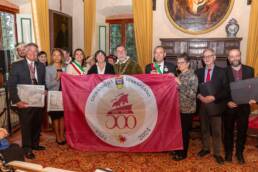
The event was attended by distinguished personalities and scholars from across the Italian-American community. The presentation took place in a packed hall specially set up with display panels telling the story of the navigator, featuring materials provided by the Foundation. Many research institutions were present. The event inaugurated a long and rich calendar of activities through which Italy and America will come together to celebrate and recount Verrazzano, renewing their spirit of brotherhood.
We extend our thanks to the many attendees, including:
-
Alessandra Oliva, Deputy Consul, Consulate General of Italy in NY
-
Lucrezia Gioia Linda (IHCC-NY board member), President of the Società Onoraria Italica
-
AATI (American Association of Teachers of Italian)
-
Anthony Tamburri, Dean of the Calandra Institute (IHCC-NY)
-
John F. Calvelli, Executive Vice Chair, NIAF (National Italian American Foundation)
-
Don Luigi Portarulo, parish priest of Our Lady of Pompei, NYC
-
Joan Migliori Marchi, President, Associazione Toscana New York
-
Gina Biancardi, President, Fondazione Casa Belvedere
-
Maria Vitagliano, Sorbello Foundation
-
Maria Palandra, Principal, Scuola d’Italia
-
Barbara Marciandi, Comites
-
Giampiero Pagliaro, MSC (Mediterranean Shipping Company)
-
Claudia Massimo Berns, Italian Affairs Chairman, Governor Pataki (IHCC-NY)
-
Maria Marinello, Vice President, IHCC-NY
-
Josephine Maietta, President AIAE (Association of Italian American Educators) (IHCC-NY)
-
Nancy Indelicato, Public Relations
-
Bill Russo (IHCC-NY), Membership
-
Giuliana Ridolfi Cardillo (IHCC-NY), Special Projects